Text Notices Reduce Utility Cutoffs by Half
February 04, 2026 by Shauna Seaver

Notifying utility customers at risk of service cut-off is not a pleasant or easy task. For the city of Sevierville, Tennessee, customer contact was made even more cumbersome by a growing community and increased service area. The city operated with four different billing cycles, necessitating delinquent account notices — from 50 to 100 — every week.
Andrea Madison, Sevierville’s accounting technician and utility billing clerk, explained the manual process. “The only method we had for notifying customers was a notice on the billing statement they received. Other than that, if our cashiers or customer service reps had time, we would attempt to contact them ourselves,” she said. When they contacted customers by phone, “it would take up quite a bit of time and tie up our phone lines.”
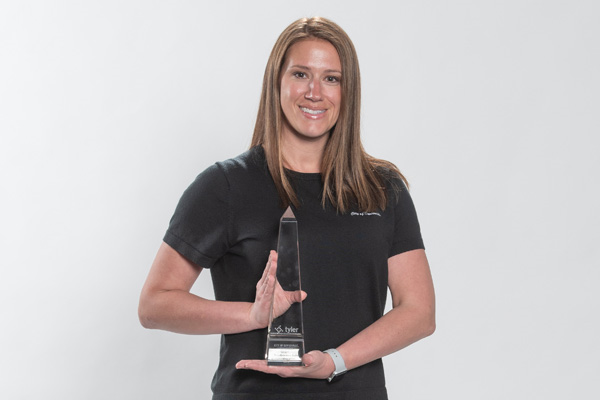
Andrea Madison, an accounting technician and utility billing clerk for the city of Sevierville, Tennessee, accepts a 2019 Tyler Excellence Award for innovation.
She and her team sought an easier, more consistent method of customer communication. “Technology is a huge part of our growth,” Madison said. “The more we can communicate through technology in different ways, the better it is for our customers.”
The city leveraged an automated notification solution that worked with its existing financial software. This not only increased internal efficiency, but it decreased utility cutoff numbers by half — a true “win-win” for the city and its residents.
Today, instant phone, email, and text notifications for delinquent customers help ensure adequate warning and allow customers to immediately make a payment through Interactive Voice Response (IVR) or by clicking a link to the online payment system. For Madison, it’s a matter of simply customizing the message, selecting the accounts, and scheduling the notification.
Customers appreciate this proactive contact, along with the opportunity to make easy payments before service cutoff. Meter technicians are enjoying reduced time in the field to handle disconnects, and customer service staff are spending less time on the phones. This helps the city increase productivity and provide its residents with better service.