Busting Common Myths About School Transportation Technology
March 13, 2026 by Becky Metivier
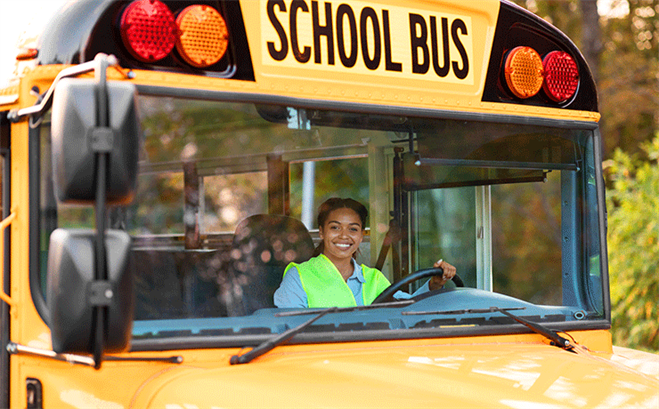
From the traditional yellow school bus to vans and beyond, drivers carry one of the most important responsibilities in education: getting students to and from school safely, consistently, and on time. Because of that responsibility, it’s natural for drivers to have questions when new transportation technology is introduced. Even tools designed to help can feel disruptive at first, affecting familiar routines, confidence, and the day-to-day rhythm of operations.
Across the country, however, many drivers who initially felt skeptical about using in-vehicle technology have ended up saying the same thing: “This actually makes my job easier.” One technology that is making things easier is Tyler Drive, an in-vehicle tablet for GPS navigation and driver support. Tyler Drive is designed to reduce paperwork, improve route clarity, and help drivers stay focused on safe driving.
In this post, we’re separating myth from reality by addressing some of the most common misconceptions about school transportation technology — and sharing what drivers typically experience once these tools become part of their daily routines.
Myth #1: “I’ve been doing this job for years without technology — I don’t need it now.”
Reality: Your experience is irreplaceable. Tyler Drive was built to support, not override, your professional judgment.
Instead of juggling paper route sheets, handwritten logs, or changing stop lists, Tyler Drive streamlines your day so you can focus fully on safe driving. Experienced drivers consistently report that after a short adjustment period, the technology becomes a helpful extension of their routine — not a replacement for their skill.
Myth #2: “This will be too complicated to learn.”
Reality: Tyler Drive was designed specifically for school bus drivers, not tech experts.
The touchscreen shows only the information you need at each moment in your route. Training is hands-on, straightforward, and quick to learn. Most drivers gain confidence using the tablet within a single run, and ongoing support is always available.
Myth #3: “It will slow down my route.”
Reality: Tyler Drive often helps drivers stay on time more consistently.
Because it automatically records student ridership, eliminates manual trip sheets, and provides real-time navigation, drivers spend less time on administrative tasks and more time doing what matters most — getting students to their destination safely and on schedule.
Myth #4: “If the system freezes or loses signal, I’ll be stuck.”
Reality: Tyler Drive is designed to work even if cellular service drops.
Planned routes and stops are stored locally on the device, ensuring you always have what you need. Once the connection returns, the system automatically updates. You stay in control, no matter what.
Myth #5: “This is just one more device I have to manage.”
Reality: Tyler Drive requires no extra work before or after your run.
It stays mounted in the vehicle, turns on automatically, and loads your assigned route for the day. You simply sign in and begin your route — no extra equipment to carry or remember.
Myth #6: “The district just wants to track us.”
Reality: Tyler Drive tracks the vehicle and the route — not the driver.
This transparency protects both drivers and the district. In many cases, Tyler Drive’s GPS data has helped to defend drivers against false accusations of missed stops or unsafe driving. The system creates clarity, not surveillance.
Myth #7: “This will distract me from driving.”
Reality: Tyler Drive is built with safety at its core.
The screen displays only what’s required, uses clear audio cues, and doesn’t require interaction while the bus is moving. Many drivers say it actually reduces distractions by replacing cluttered paper routes or last-minute changes with real-time, accurate information.
Myth #8: “Students will mess with the tablet.”
Reality: The device is securely mounted, locked down, and out of reach.
The display also dims while driving, so it doesn’t draw students’ attention. The system is engineered to serve the driver — not become a passenger curiosity.
Myth #9: “We already know our routes. Why do we need GPS?”
Reality: Routes change constantly throughout the year — and drivers aren’t always assigned to their usual runs.
Myth #10: “This is just another way to control drivers.”
Reality: Tyler Drive promotes consistency, safety, and fairness, not control.
It ensures students are picked up where and when they should be, gives parents reliable information, and reduces confusion and blame during operational challenges. The system creates transparency that benefits everyone.
The bottom line – technology should empower drivers and Tyler Drive does exactly that.
At Tyler, we believe in innovation grounded in responsibility. That means building technology that supports the people who use it — especially school bus drivers who carry the enormous duty of transporting students safely.
Tyler Drive was created to make your day easier, not harder. Across the country, drivers who once had concerns now say they feel more prepared, more supported, and more confident behind the wheel.